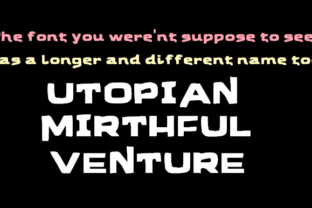
Utopian Mirthful Venture: A Journey Through Typographic Innovation
The story of Utopian Mirthful Venture is a tale of creativity, evolution, and the intricate dance between inspiration and originality in the world of typography. Originally conceived as F.E. E. for Fun Euro and Experimentation, this font was never intended for public use or completion. It began as a playful exploration, a whimsical attempt to capture the spirit of experimentation that defines many design processes.
In 1986, SWMCA operated as a sign painting business with a reputation for its typographic catalogs. The need for a version of Eurostile emerged, but each attempt felt too cartoonish. This early phase of development highlights how even the most creative ideas can be constrained by practical considerations. It also underscores the importance of aligning design choices with the broader goals of a project or business.
The Evolution of a Design Concept
Fast forward to late 2007, when SWMCA became aware of Typeright, an organization dedicated to protecting the rights of fontographers and others in the typographic community. Typeright's stance against copycat or clone fonts prompted a reevaluation of existing designs. While the original F.E. E. was undeniably cartoonish, it still bore a striking resemblance to Eurostile, raising concerns about potential legal issues.
This led to a pivotal moment in 2008, when SWMCA developed two prototypes to address these concerns: F.E. E. No. 1 and No. 2. These were not meant for release but served as experimental iterations, allowing the team to explore the boundaries of their creative vision while adhering to ethical and legal standards. The process involved extensive experimentation with Eurostile and its predecessor, Microgamma, resulting in a font containing 61 characters.
By 2009, a new and radically different version of Fun Euro was introduced, which eventually took on the name "Fun Euro." This marked a significant shift in the font's identity, reflecting a more refined and distinct approach to typography. The original 1986 design was subsequently renamed, illustrating how a single concept can evolve through multiple iterations, each contributing to the final product.
Integrating Utopian Mirthful Venture into Workflows
Understanding the journey of Utopian Mirthful Venture provides valuable insights into how such a font can be integrated into various workflows. Whether used before, during, or after a project, the font offers a unique aesthetic that can enhance visual communication. Its history as an experimental prototype suggests that it may be particularly suited for creative projects that value innovation and originality.
For professionals in fields such as graphic design, marketing, or content creation, Utopian Mirthful Venture can serve as a tool to differentiate their work. It encourages a process-oriented approach, where the choice of typography is not merely aesthetic but also strategic. By selecting a font that reflects a brand's identity or a project's narrative, creators can ensure consistency and coherence in their output.
The font's evolution also highlights the importance of adaptability in design. As trends change and new tools emerge, the ability to refine and update one's approach becomes essential. Utopian Mirthful Venture exemplifies this principle, demonstrating how a design can be reimagined to meet contemporary needs while maintaining its core identity.
Practical Implementation Tips
When considering the use of Utopian Mirthful Venture, it is important to assess its compatibility with other design elements. This includes ensuring that the font works well with other typefaces, colors, and layouts. A cohesive visual hierarchy is crucial for effective communication, and the font should complement rather than compete with other components of the design.
Additionally, usability is a key factor in the success of any font. While Utopian Mirthful Venture may offer a distinctive look, it should also be legible and accessible across different platforms and devices. Testing the font in various contexts—such as print, digital media, and web applications—can help identify potential issues and ensure a seamless user experience.
For those working within a team, collaboration is essential. Sharing the font with colleagues and stakeholders allows for feedback and refinement, ensuring that the final product meets the needs of all parties involved. This collaborative approach not only enhances the quality of the work but also fosters a culture of innovation and continuous improvement.
Long-Term Use and Maintenance
Considering the long-term use of Utopian Mirthful Venture involves planning for updates and maintenance. As technology evolves, it may become necessary to revisit the font's design to ensure it remains relevant and functional. This could include adjusting character spacing, refining glyphs, or adapting the font for new formats and platforms.
Maintaining a consistent quality across different applications is also vital. Regular audits of the font's performance can help identify areas for improvement and ensure that it continues to meet the standards of the industry. This proactive approach not only extends the lifespan of the font but also reinforces its value as a reliable tool in the design process.
Ultimately, the journey of Utopian Mirthful Venture serves as a reminder of the dynamic nature of design. It illustrates how a simple idea can evolve into something meaningful, shaped by the interplay of creativity, ethics, and practicality. By understanding this process, designers and professionals can make informed decisions that align with their goals and values.